
KPM Franklin’s civil engineers are experts at integrating Florida’s new statewide stormwater rules into our design workflows and working with companies that provide alternative stormwater systems. By utilizing advanced modeling tools, we help our clients in Central Florida maximize their buildable acreage while ensuring full compliance with the new FDEP stormwater rules.
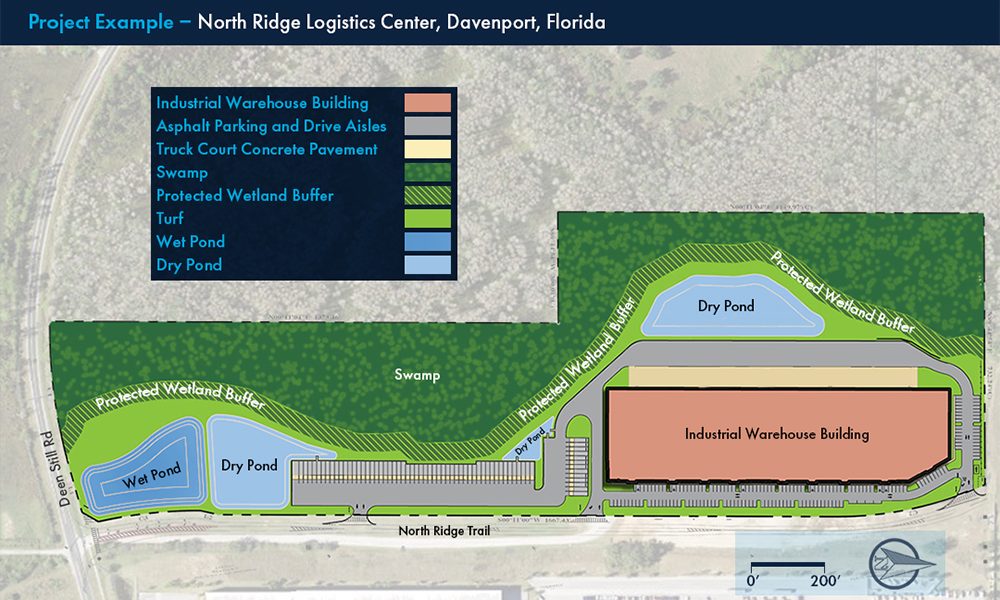
Our engineers applied the state’s new stormwater rules standards in the site design for the North Ridge Logistics Center project in Davenport, Florida. The design combines a wet pond, three dry ponds and a protected wetland buffer to ensure nutrient pollution is reduced in stormwater runoff from impervious areas where an industrial warehouse building, truck loading area and parking lot are located before leaving the site.
Florida’s New Statewide Stormwater Rules
On June 28, 2024, Governor Ron DeSantis signed Senate Bill 7040 (SB 7040) into law which officially ratified the most substantial updates to Florida’s statewide stormwater rules in decades. SB 7040 confirmed the Florida Department of Environmental Protection’s (FDEP) revisions to Chapter 62-330, F.A.C. that establishes statewide thresholds, criteria and conditions for FDEP, water management districts (WMDs) and delegated local programs to process and issue environmental resource permits (ERPs).
FDEP’s main goal is to ensure that stormwater runoff at new developments is adequately treated to ensure nutrient pollution, such as nitrogen and phosphorus, has been significantly reduced in stormwater before it enters waterbodies.
While FDEP’s previous stormwater system design standards just assumed nutrient reductions were met once volumetric design standards were met, the new standards require civil engineers to prove that their stormwater system design provides required nutrient reduction for their site based on the areas specific nutrient impairments.
This applies to larger or additional treatment systems such as ponds, underground systems or filtration structures. Also, any redevelopment project on a site larger than one acre must now implement a stormwater treatment system, regardless of the site’s previous condition.
The new rules require standards to be modernized by incorporating updated scientific information for stormwater management design, construction and operation,
ERP permit applicants must provide a cost estimate for annual maintenance and lifetime replacement of the stormwater system.
Additional criteria has been incorporated for dam systems to reduce risks of failure, flooding and uncontrolled releases that could degrade water resources.
Florida is moving toward a life-cycle approach to infrastructure. Permit applicants must now provide a cost estimate for the annual operation and maintenance of the stormwater system and certify that they have the financial capability to fund these costs perpetually.
Systems must undergo periodic inspections by a licensed professional engineer to ensure they continue to function as designed. These results must be reported directly to the presiding state Water Management District.
The follow is a summary of how Senate Bill 7040 is affecting new developments in Central Florida.
Impact on Buildable Area
Meeting the higher nutrient removal targets may require larger retention areas or the integration of Green Infrastructure, such as biosorption-activated media, rain gardens or underground treatment chambers. Alternatively for projects where land comes at a premium and impairment conditions can be harsh, alternative solutions, such as activated media, would be an added new cost.
Budgeting for the Life Cycle
Project budgets must now account for long-term operations and maintenance from day one. Failing to plan for these recurring costs could lead to permitting delays or compliance issues down the road.
Grandfathering Window
While the rule is technically in effect, there are specific provisions for projects already in the pipeline. If an application has been deemed complete on or before December 28, 2025, it may be evaluated under the previous standards. Projects with approved ERPs, permits or certain pending applications that were filed before June 28, 2024, are exempt.
Our engineers applied the state’s new stormwater rules standards in the site design for the North Ridge Logistics Center project in Davenport, Florida. The design combines a wet pond, three dry ponds and a protected wetland buffer to ensure nutrient pollution is reduced in stormwater runoff from impervious areas where an industrial warehouse building, truck loading area and parking lot are located before leaving the site.
Florida’s New Statewide Stormwater Rules
On June 28, 2024, Governor Ron DeSantis signed Senate Bill 7040 (SB 7040) into law which officially ratified the most substantial updates to Florida’s statewide stormwater rules in decades. SB 7040 confirmed the Florida Department of Environmental Protection’s (FDEP) revisions to Chapter 62-330, F.A.C. that establishes statewide thresholds, criteria and conditions for FDEP, water management districts (WMDs) and delegated local programs to process and issue environmental resource permits (ERPs).
FDEP’s main goal is to ensure that stormwater runoff at new developments is adequately treated to ensure nutrient pollution, such as nitrogen and phosphorus, has been significantly reduced in stormwater before it enters waterbodies.
While FDEP’s previous stormwater system design standards just assumed nutrient reductions were met once volumetric design standards were met, the new standards require civil engineers to prove that their stormwater system design provides required nutrient reduction for their site based on the areas specific nutrient impairments.
This applies to larger or additional treatment systems such as ponds, underground systems or filtration structures. Also, any redevelopment project on a site larger than one acre must now implement a stormwater treatment system, regardless of the site’s previous condition.
The new rules require standards to be modernized by incorporating updated scientific information for stormwater management design, construction and operation,
ERP permit applicants must provide a cost estimate for annual maintenance and lifetime replacement of the stormwater system.
Additional criteria has been incorporated for dam systems to reduce risks of failure, flooding and uncontrolled releases that could degrade water resources.
Florida is moving toward a life-cycle approach to infrastructure. Permit applicants must now provide a cost estimate for the annual operation and maintenance of the stormwater system and certify that they have the financial capability to fund these costs perpetually.
Systems must undergo periodic inspections by a licensed professional engineer to ensure they continue to function as designed. These results must be reported directly to the presiding state Water Management District.
The follow is a summary of how Senate Bill 7040 is affecting new developments in Central Florida.
Impact on Buildable Area
Meeting the higher nutrient removal targets may require larger retention areas or the integration of Green Infrastructure, such as biosorption-activated media, rain gardens or underground treatment chambers. Alternatively for projects where land comes at a premium and impairment conditions can be harsh, alternative solutions, such as activated media, would be an added new cost.
Budgeting for the Life Cycle
Project budgets must now account for long-term operations and maintenance from day one. Failing to plan for these recurring costs could lead to permitting delays or compliance issues down the road.
Grandfathering Window
While the rule is technically in effect, there are specific provisions for projects already in the pipeline. If an application has been deemed complete on or before December 28, 2025, it may be evaluated under the previous standards. Projects with approved ERPs, permits or certain pending applications that were filed before June 28, 2024, are exempt.